I am Dr. Zack Tilden. I practiced general and cosmetic dentistry for 10 years and sold my practice in 2026 to build Lecron. The weakest part of my own work was the part I could not see. What happened to a case between the day I sent it and the day I opened the box.
A dentist who sent you eight cases a month sends four. Then two. Then none, and nobody in your lab knows why. This article gives you the four signals that show up first, a one hour monthly report that catches them, and the words to say on the call.
Most labs never get a complaint. They get an empty case pan four months later. It starts with one case where the dentist had to chase you. An upper central goes on hold in March, the change gets described over the phone, and the case ships two days late. The crown seats fine and nobody writes any of it down. By July that practice has sent nothing, so the owner asks: "I am not seeing many cases from your office anymore, is everything alright?" The answer is the one every lab owner has heard. "Business has just been slow lately, but I will try to send you some more cases."
What dentists say when they leave, and what they mean
That answer is almost never the real reason. Most dentists know the technician personally and will not insult someone's craft, so they reach for a reason that hurts nobody.
| What they say | What it usually means |
|---|---|
| "Business has been slow." | I moved my cases somewhere else. |
| "We are just trying another lab for a while." | I already switched and I am softening it. |
| "Your prices went up a little." | Price was the reason I felt allowed to say out loud. |
| "It was easier to order from them." | Your ordering process cost me staff time every case. |
| "They keep me in the loop." | I could not see my case, and I hated that. |
| "The fit has been fine, no complaints." | I have complaints. I am not going to list them. |
Two things follow. Wait for a complaint and you will never get one. And price is what a dentist says instead of the real reason: nobody leaves a six year lab over a small fee difference.
It is not your crown work
Labs lose dentists over visibility and communication, not craftsmanship. A dentist who has used you for six years already knows your margins are clean and your contacts are right. That is why they stayed.
What breaks is everything around the case. Three failure points do most of the damage.
A hold turns into three days of phone tag. Your technician needs one answer about an incisal edge, the dentist is with a patient, and the answer comes back the next afternoon on a call nobody writes down. The technician makes a best guess.
The dentist cannot see the case progress or the design. They scan the patient, hit send, and the case is gone for 7-12 days. They find out how it turned out at the same moment the patient does, in the chair.
Lab staff are not checking back in to see how the case turned out, and nobody collects case feedback on a schedule. Most labs hear about a case only when a dentist complains, so the only cases in your records are the ones that already went wrong. The case a dentist quietly disliked is never recorded anywhere.
Your technicians are not the problem. The problem is that everything around the case is invisible, to the dentist and to you.
Four signals that show up before a dentist leaves
Every one of these is visible with what you already have.
Signal 1. Volume drops, but the orders do not stop.
A dentist testing another lab moves a few molar crowns first, so your count falls by a third while the account still looks active.
Signal 2. The case mix changes before the case count does.
A dentist who used to send anterior, implant, and full arch work and now sends only single posterior units is keeping you for the low risk cases.
Signal 3. A case had friction, and nobody followed up.
Look for cases that went on hold, were remade, shipped late, or took more than two calls. If nobody called after the case closed, the dentist filed it away and told you nothing.
Signal 4. They stop asking for things.
When the questions about previews, shades, and technicians stop and the orders keep coming, that is a warning, not a compliment.
How to build a fading account report this week
A spreadsheet and one hour a month is enough. Every lab system can export a case list with a date and a doctor name.
Step 1. Export the last twelve months of cases with the date, the doctor, the practice, and the product type.
Step 2. Build a table with one row per doctor and one column per month. Fill in the case count for each month.
Step 3. Add three columns: cases in the most recent full month, average monthly cases over the six months before it, and the percent change between them. Use six months, not twelve, because a twelve month average hides a drop that started in March.
Step 4. Sort by percent change, worst first. Anything down by 30 percent or more goes on your call list. That threshold is a starting point, not a benchmark from research.
Step 5. Add a second sheet with every case in the last 90 days that went on hold, shipped late, or was remade. Any doctor who appears twice goes on the call list, even if their volume looks fine.
Step 6. Put a recurring appointment on the calendar for the first Monday of every month, one hour, same person every time. A report nobody owns stops getting made by month three.
Run this once and you will find accounts you did not know were fading. Nobody sends you an invoice for the dentist you lost, so the cost never shows up in your numbers until you go looking for it.
What to say in the first conversation
Somebody has to call, and most labs skip this because it feels awkward. The goal is not to save the account in one call. It is to get the real reason.
Situation
A dentist's volume has dropped and you do not know why.
Say this
"Dr. Patel, this is Marta at Northside Dental Lab. I am not calling about a case. I noticed we have been doing less work for you than we used to, and I wanted to ask directly if something on our end made that harder for you. I would rather hear it than guess."
Why it works
You named the drop so they do not have to, you asked one question, and you took the blame first. Then you let silence do the work.
Then stop talking and let them answer.
If they say business has been slow, ask one gentle follow-up.
Say this
"That is fair. If there was one thing about working with us you would change, what would it be?"
Why it works
It asks about a process, not a person. Dentists answer that far more honestly than they answer "was there a problem."
Write the answer down word for word and do not defend anything on the call. Say thank you, fix the thing, and call back to say it is fixed. The callback saves the account, not the first call.
Do the same after any case with friction. A call the week after a remake is the cheapest retention work a lab can do. Twenty-five of these conversations are in our free script pack for lab staff: delays, holds, remakes, and the calls nobody wants to make. Answering a dentist well is its own skill, and we wrote that up too, in the concierge lab.
Where Lecron fits
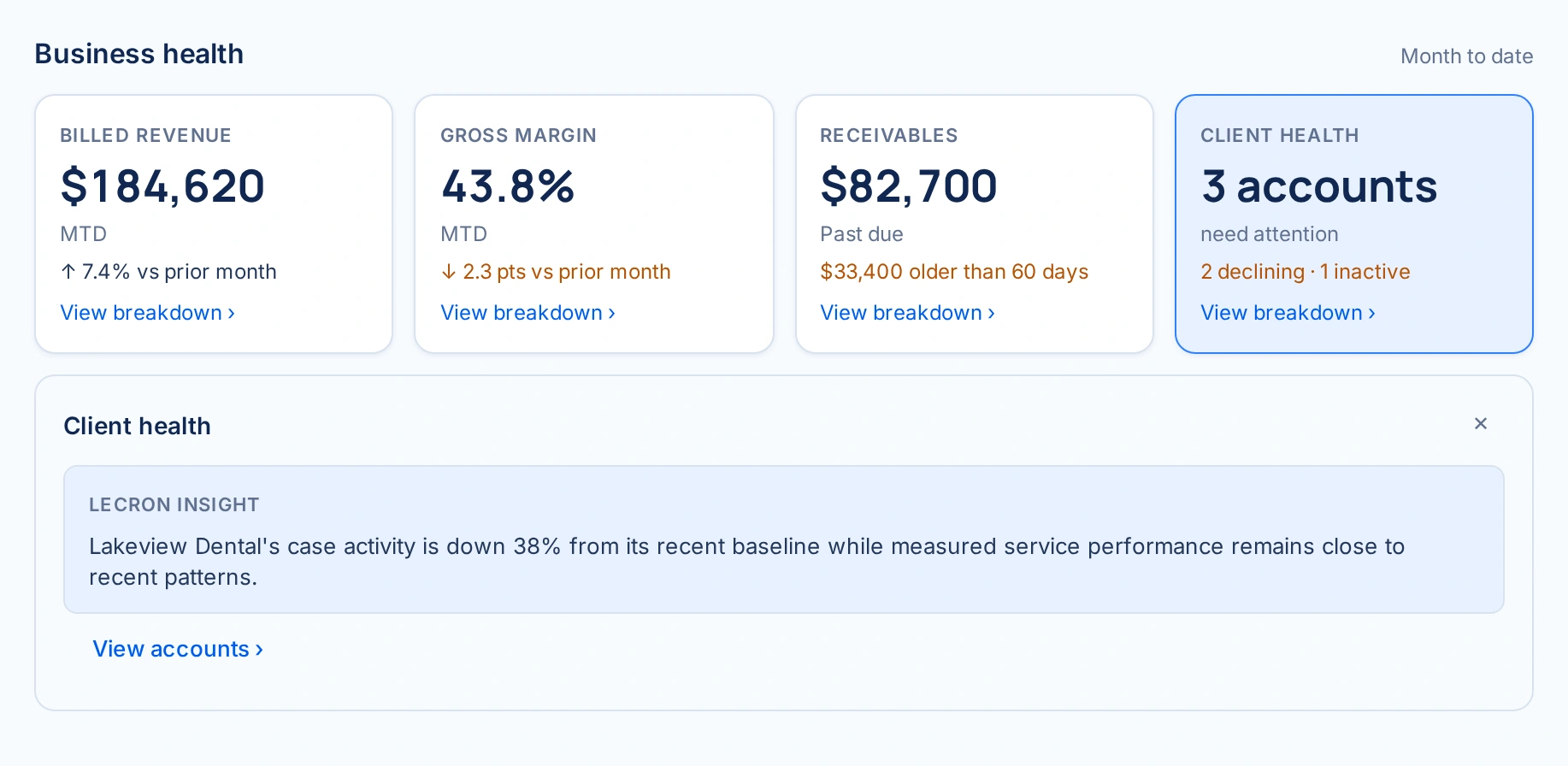
Lecron closes those three gaps and then watches them for you. It shows the dentist the design before the case is milled, so they approve it from their phone. It collects one-click feedback on every case, so a quiet problem shows up the week it happens. And it tracks holds, late shipments, feedback scores, and each doctor's ordering pattern, so when an account drifts you get the name to call and what changed. It runs under your lab's name.
See this with your own lab's cases. Request a demo.
Do this today: export your last twelve months of cases and compare each doctor's last full month against the six months before it. Call the top three names on that list before Friday.